Hunting for Trout on Mars

Why writing about worlds you've never experienced is harder than it looks
By Jeremy Clift, author of Born in Space: Unlocking Destiny
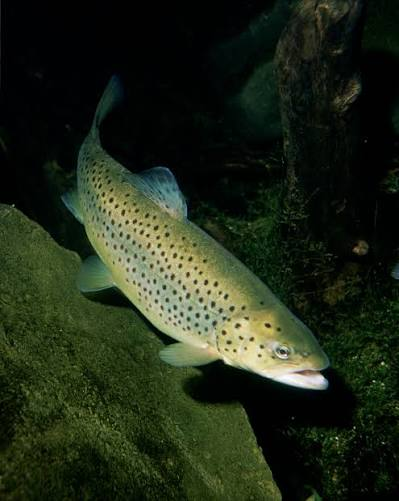
In Blood Meridian, Cormac McCarthy describes a moment when a party of riders descends into a streambed in the American West:
“They descended by rocky switchbacks and across the beds of streams where small trout stood on their pale fins and studied the noses of drinking horses.”
I love that image. The trout hovering in the clear water, the horses lowering their heads to drink, the fish apparently regarding these enormous intruders with curiosity. McCarthy gives us a whole world in a single sentence. Nothing particularly dramatic happens, yet the scene feels extraordinarily alive.
And it occurred to me, while working on my latest science-fiction novel, that I couldn't write anything quite like it.
Paul Torday imagined Salmon Fishing in the Yemen, an improbable scheme to introduce salmon to a desert country. But at least his characters had real fish to work with. On Mars, I have neither fish nor flowing streams, and no firsthand experience of whatever might be lurking beneath the surface.
McCarthy was writing about a landscape that existed, or at least one that had existed within human memory. He could draw on the accumulated experience of travelers, naturalists, historians, and anyone who has ever watched a fish holding its position against a current. His genius lay in noticing, selecting, and arranging those details into something memorable.
Science-fiction writers face a rather different challenge. We frequently describe places nobody has visited, environments nobody has experienced and events that have never occurred. We cannot rely on a reader's memory of a mountain stream, a summer meadow or the smell of rain on warm earth. We have to construct those experiences from scratch. And we have to make readers believe them.
When the animals are electric
Philip K. Dick approached the relationship between humanity and nature from another direction in Do Androids Dream of Electric Sheep?, his 1968 novel that inspired the film Blade Runner.

In Dick's devastated future, living animals have become so scarce that owning one is a mark of social status. People who cannot afford the real thing make do with electric substitutes. The novel's protagonist, Rick Deckard, keeps an artificial sheep, a mechanical imitation of an animal that once formed part of the ordinary natural world.
The contrast with McCarthy is striking. McCarthy's trout are so unremarkable to the riders passing through the landscape that nobody pays them any attention. Their beauty emerges from the writer's observation. In Dick's world, an encounter with a genuine animal has become something extraordinary, and the distinction between living creatures and their mechanical counterparts raises uncomfortable questions about authenticity, empathy, and what it means to be alive.
Dick was writing about a future in which humanity had lost much of the natural world it once took for granted. His artificial animals represent an attempt to preserve the appearance of a relationship with nature after much of nature itself has disappeared.
But his novel also suggests a problem for writers imagining humanity's expansion beyond Earth. What happens when people grow up in environments where the familiar natural world has never existed?
A child raised in a space habitat might know what a trout looks like from photographs, videos, or an aquarium. The child might even have encountered an artificial trout, engineered to swim through a carefully maintained stream. But would that child understand McCarthy's description of fish studying the noses of drinking horses? Would the image evoke anything beyond curiosity about a distant and unfamiliar world?
And could someone miss a trout without ever having seen one?
That question has stayed with me while writing science fiction, because it goes beyond the challenge of describing unfamiliar landscapes. It asks how our surroundings shape our emotions, our memories and ultimately our sense of what it means to be human.
The tyranny of the familiar
Think about how much ordinary fiction depends on shared experience. A novelist can mention the smell of freshly cut grass, the sound of a train passing at night or the sight of sunlight filtering through autumn leaves, and the reader immediately supplies a wealth of associations.
Even when a writer introduces a landscape unfamiliar to the reader, the basic materials remain recognizable. Rivers flow downhill. Trees bend in the wind. Birds scatter when startled. Rain falls from clouds.
These details provide more than scenery. They create atmosphere, reveal character, and give readers a sense of physical presence. The best writers make us feel that we are inhabiting a world rather than simply being told about it. Now imagine trying to achieve the same effect on the Moon.

The sky is black even at noon. Shadows are sharp because there is no atmosphere to scatter sunlight. Dust does not drift in the wind because there is no wind. Footsteps make no sound through the vacuum outside a spacesuit, although vibrations can travel through the suit itself. A dropped object falls with one-sixth of Earth's gravitational acceleration.
Every familiar detail has to be reconsidered.
A writer cannot casually describe a breeze stirring the dust, or the smell of the lunar landscape, without first explaining the physical circumstances that make such sensations possible. Even a seemingly innocent description of someone watching Earth rise above the lunar horizon can be wrong, depending on where the observer is standing. From most fixed locations on the Moon's near side, Earth hangs in roughly the same part of the sky.
The constraints are fascinating, but they can also be exhausting.
The writer's imagination must operate within the laws of physics, or at least within a coherent set of rules that readers will accept. A beautifully written description can lose its power if an informed reader notices that the writer has casually introduced an atmosphere where none exists.
Yet the greater challenge is not simply avoiding scientific errors. It is discovering the sensory details that make an unfamiliar world feel inhabited.
McCarthy can describe trout because trout exist. What is their equivalent on the Moon?
Can you miss something you've never experienced?
When I began writing Born in Space: Unlocking Destiny, the first novel in my Sci-Fi Galaxy series, I wanted to explore the lives of children born beyond Earth, growing up in orbital habitats and lunar settlements.
The scientific questions were formidable. How would pregnancy and childbirth work in reduced gravity? What would prolonged exposure to radiation do to developing bodies? Could a child raised on the Moon ever comfortably live on Earth?

Research helped me explore those questions, although many of the answers remain uncertain.
But another problem gradually became more interesting to me. How would these children experience a world that was entirely normal to them but profoundly alien to us?
What would a child born in space regard as home? Would Earth inspire longing, curiosity or fear? Would the child regard the planet as humanity's birthplace, or simply as an enormous, dangerous world with crushing gravity and an impossibly deep atmosphere?
Would such a child dream of walking through a forest? Perhaps not. We tend to assume that the experiences we value are universally desirable, but much of what we love about the natural world comes from familiarity, memory and association.
The smell of rain may remind us of childhood. The sound of waves may evoke holidays, freedom or the passage of time. A forest can offer comfort because we associate trees with shelter, shade and the rhythms of the seasons.
Someone who has never experienced those things may not feel their absence.
Instead, a child growing up in an orbital habitat might find reassurance in the steady hum of air circulation systems, the familiar curvature of a rotating corridor or the sight of Earth suspended beyond a window. The gentle pull of artificial gravity might seem natural, while the full gravity of Earth would feel oppressive.
The child's memories and emotional associations would be built around experiences that terrestrial humans have never had.
This is where science fiction becomes especially interesting to me. The physical environment is not simply a backdrop for the characters. It helps shape their identities.
Philip K. Dick imagined people trying to preserve a relationship with animals they were losing. In Born in Space, I wanted to explore people who might never develop that relationship in the first place.
The distinction is important. Dick's characters can mourn what has disappeared. My space-born children may have no reason to mourn what they have never known.
Perhaps they would pity those of us who are permanently confined to the surface of a planet.
Research can tell you what is possible. It cannot tell you what it feels like.
Scientific research is essential to writing convincing science fiction, especially when the story depends on plausible technology and environments.
But research has its limitations.
Scientific papers are excellent at explaining mechanisms, measurements, and probabilities. They are less helpful when you want to know what it feels like to wake up in a rotating space habitat, look through a window at Earth and realize that the planet below is somewhere you have never been.

We can calculate the gravitational forces experienced by someone living in a rotating habitat. We can model the effects of radiation exposure and estimate the engineering requirements of a settlement on the Moon. But how would a child feel on discovering that the planet regarded by most of humanity as home is somewhere they might never visit?
These are questions that science cannot answer for us. They belong to fiction.
Yet even the most speculative answers need to be grounded in something recognizable. A child's attachment to a parent, the anxiety of entering an unfamiliar place, the pleasure of movement, the excitement of discovering something new: these are experiences we understand. They provide a bridge between our world and an imagined one.
The challenge is to carry those emotions into a physical environment that obeys very different rules.
A writer must make the reader feel at home in a place that has never been anyone's home.
Mars is not the American West
My current project that is based on Mars has brought this problem into sharper focus.
Mars offers a wonderfully dramatic setting. Its enormous volcanoes, ancient river channels, dust storms, and buried ice suggest a world with a complex geological history. Olympus Mons towers above the surrounding plains, while the planet's thin atmosphere and bitter temperatures make ordinary human activity a logistical challenge.

NASA's rovers have given us remarkable photographs of the Martian surface. We can study its rocks, dunes, craters, and sedimentary layers in extraordinary detail. We have maps, measurements and increasingly sophisticated models of its climate and geological past.
But photographs are not experience.
Nobody has stood on Mars and watched the afternoon light change across the landscape. Nobody has listened to the faint sound of a Martian wind through a human ear, unmediated by instruments. Nobody has walked into a pressurized settlement after a long excursion and felt the peculiar relief of removing a helmet while the planet's red dust clings to the equipment outside.
We can calculate, extrapolate, and imagine, but we cannot remember. McCarthy could give his trout an almost human curiosity because the behavior was plausible and immediately recognizable. On Mars, I cannot simply substitute an imaginary creature and expect the same result.
If I invent a Martian organism, I have to consider how it evolved, where it obtains energy, how it responds to its environment and whether it could survive under the conditions I have established.
An invented animal that behaves exactly like an Earth animal may feel familiar, but it can also make the alien world seem suspiciously terrestrial.
On the other hand, a completely incomprehensible organism risks leaving readers emotionally detached.
The writer must find a balance between scientific credibility and imaginative accessibility.
And Mars presents an additional difficulty. We do not know whether life ever existed there, much less whether anything survives beneath its surface today. The scientific uncertainty gives a novelist enormous freedom, but it also creates a responsibility to distinguish plausible speculation from fantasy.
The danger of writing about machinery
Science fiction has another temptation: technology. Spaceships, habitats, robots, propulsion systems, artificial intelligence and planetary engineering offer endless opportunities for invention. I enjoy researching these subjects, and they play a substantial role in my novels.
But machinery can overwhelm the human experience. A writer may spend pages explaining how a spacecraft operates while neglecting the small observations that make its interior feel inhabited. What does a crew member notice during an ordinary breakfast? How does a familiar corridor change after a death? What sounds become comforting after months aboard a vessel? What small personal objects does someone carry from one habitat to another?
A convincing future needs the equivalent of McCarthy's trout.
It needs incidental details that do not exist solely to advance the plot or explain the technology. It needs moments when characters observe their surroundings simply because they are living in them.
Perhaps a child in a rotating habitat watches a bead of water escape from a drinking pouch and drift toward the low-gravity central axis. Perhaps a lunar worker notices how fine dust has collected in the folds of a colleague's suit. Perhaps someone on Mars becomes so accustomed to the muted colors of the landscape that a tray of green seedlings in a greenhouse seems almost painfully vivid.
These observations need not be spectacular. Their power comes from making the extraordinary feel ordinary.
I suspect this is one reason some science-fiction settings feel more convincing than others. The most successful imagined worlds have acquired a sense of everyday life. People eat, quarrel, fall in love, complain about their surroundings and develop habits that make sense within the environment.
The technology becomes part of the furniture.

In The Expanse, for example, the physical consequences of living in space help shape the cultures and identities of the people who inhabit it. The differences between those raised on Earth, Mars, and in the asteroid belt extend beyond politics and economics into the ways their bodies develop and the environments they regard as natural.
That attention to lived experience helps make the imagined future convincing.
The writer has to understand the technology well enough to stop talking about it all the time.
Don’t explain too much
Sometimes the most powerful detail is the one the writer leaves unexplained.
McCarthy's trout are memorable partly because he does not tell us what they are thinking. He gives them a human quality through the simple verb "studied," but he leaves their behavior open to interpretation. The reader supplies the rest.
Perhaps a science-fiction writer should aim for something similar when describing alien life. Instead of explaining its biology, psychology, and evolutionary history, perhaps we should occasionally allow readers to observe it without fully understanding it.
After all, much of our fascination with nature comes from recognizing that other living things inhabit worlds we can never entirely enter.
A trout does not experience a stream as a horse does. A horse does not experience the landscape as a human rider does. McCarthy brings these different worlds together in a fleeting moment of mutual observation.
Science fiction can take that encounter much further, inviting us to imagine not only worlds we have never seen, but ways of experiencing existence that we may never fully understand.
— Jeremy Clift, author of Born in Space, Space Vault, and Space Shield. Read Clift’s profile on Kirkus.


Comments