Why Is Science Fiction So Fascinated by Fungi?


By Jeremy Clift, author of Born in Space: Unlocking Destiny
Imagine an intelligence with no brain, no nervous system, and no central command. It can find food, navigate obstacles, build efficient networks, and adapt to its surroundings. Cut it apart and it may continue functioning. Give it time and it can spread across an extraordinary area, responding to a world it cannot see, hear, or understand in anything resembling the way we do.
It sounds like the starting point for an alien species in a science-fiction novel.
In fact, we don't have to leave Earth to find it.
That was one of the more intriguing ideas I brought home from the recent World Science Fiction Convention in Los Angeles, where I found myself drawn to two panels exploring some of the strangest organisms on our own planet: Fungus Among Us: Mushrooms for Good and Evil and Too Cool to be a Fungus: Slime Molds for the Win.
The second title contains an important scientific distinction. Slime molds aren't actually fungi at all, although they were once classified that way. But fungi and slime molds share something irresistible for science-fiction writers: they behave in ways sufficiently unfamiliar to make us reconsider some very human assumptions about intelligence, communication, and individuality.
Ursula Vernon, better known to many readers as T. Kingfisher, was among the participants on the slime-mold panel. She was also the convention's toastmaster, and one of her novellas was a Hugo finalist. Her fiction has itself ventured memorably into fungal territory, most notably in What Moves the Dead.
The more I listened, the more I began to think that science fiction may have been looking for the alien in the wrong place.
We usually look upward. Perhaps we should also be looking down.
The Horror Beneath Our Feet
Fungi have always lent themselves to horror. They emerge from decay. Much of the organism remains hidden from view. They reproduce through microscopic spores that can travel unseen through the air. Some invade living organisms, while others manipulate their hosts in ways that sound as though they were invented by a particularly imaginative horror writer.
That helps explain the success of The Last of Us, in which a mutated fungal infection transforms humans into aggressive hosts capable of spreading the infection further.
The fictional leap is enormous, but the inspiration is real. Certain parasitic fungi infect insects and alter their behavior in ways that help the fungus reproduce.
That is much more unsettling than a completely invented zombie virus because nature has already supplied the basic idea.

T. Kingfisher explores similarly disturbing territory in What Moves the Dead, her reimagining of Edgar Allan Poe's The Fall of the House of Usher. Something very strange is happening around the decaying Usher mansion, and fungi lie at the heart of it.
Kingfisher has described researching real fungal biology while developing the fictional organism. That mixture of genuine science and imaginative extrapolation is precisely what makes fungi such fertile territory for speculative fiction.
The writer does not have to invent something entirely alien. Evolution has already done much of the work.
The Network
But fungi are interesting for another reason. What we think of as a mushroom is only the conspicuous reproductive structure of a much larger organism. Beneath the ground, fungal hyphae can form extensive networks known collectively as mycelium.
Those networks interact with plants, microbes and the surrounding environment. They transport nutrients and respond dynamically to changing conditions.
For a science-fiction writer, the possibilities are irresistible.
We are accustomed to imagining intelligence as something located inside a brain. One individual has one brain, which produces one mind. But what if intelligence could instead be distributed across a network?
Star Trek: Discovery takes that idea to spectacular extremes with its fictional mycelial network, an interconnected web extending throughout the universe and enabling the starship Discovery's Spore Drive to cross enormous distances.
Real fungi cannot transport spaceships across the galaxy, of course. But the underlying imaginative leap is fascinating because it asks us to think about networks as something more than passive connections between individuals.
What if the network itself mattered?
When Intelligence Doesn't Have a Brain
That question became even more intriguing at Too Cool to be a Fungus: Slime Molds for the Win. The title contains an important biological correction. Slime molds aren't fungi, despite their name and appearance. They belong to a very different branch of life.
And some of them do remarkable things.
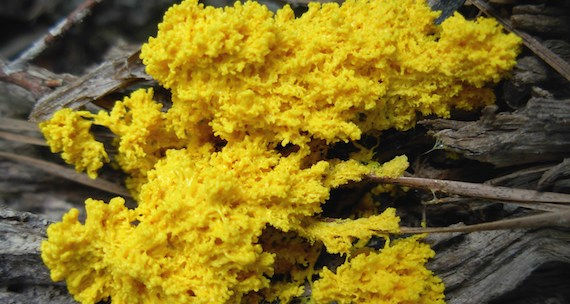
Physarum polycephalum, a bright yellow slime mold popular with researchers, has no brain and no nervous system. Yet it can navigate around obstacles, find efficient paths to food and alter its behavior according to information it has previously encountered.
One famous experiment presented the slime mold with food sources positioned to correspond with cities around Tokyo. As it grew between them, it produced an efficient network with striking similarities to the Tokyo rail system.
Nobody gave the slime mold a map. There was no central planner deciding where the next connection should go. The network emerged from millions of local responses to the environment.
That raises a wonderfully provocative question:
How much of what we call intelligence actually requires a brain?
Perhaps our definition of intelligence tells us as much about ourselves as it does about the organisms we are studying.
What Would an Alien Mind Look Like?
Science fiction has traditionally given aliens surprisingly human characteristics.
They often have faces. They speak languages. They have leaders, governments, armies, ambitions and recognizable emotions. Even when they possess six legs and blue skin, we can usually identify the individual alien with whom Captain Kirk—or whoever happens to be representing humanity—needs to negotiate.
That may turn out to be an extraordinarily narrow way of imagining extraterrestrial life.
Suppose the first complex alien organism we encounter has no brain and no permanent body.

Suppose information is distributed across thousands or millions of interconnected components. Parts of it can die without killing the whole. Separate parts can combine. It communicates chemically rather than verbally and experiences its environment through processes completely unlike sight or hearing.
Where, exactly, is the individual? Where is its memory? And if it displays behavior that suggests learning, adaptation and problem-solving, at what point would we call it intelligent?
Slime molds give science-fiction writers a way of asking these questions without leaving Earth.
Building With Fungi on Mars
Fungi also belongs to science fiction for another reason, however, and this one is considerably less sinister. They might help us live in space.
NASA researchers have been investigating what they call mycotecture: using fungal mycelium as a potential building material for habitats on the Moon and Mars.
The attraction is obvious. Launching building materials from Earth is enormously expensive. Every kilogram has to be lifted out of Earth's gravity well and transported across space.
What if, instead of transporting an entire habitat, astronauts could take a lightweight framework containing dormant fungi? Add water at the destination, provide the right nutrients and conditions, and the mycelium could grow around the framework to help create the structure itself.
NASA has already supported research into fungal-based biocomposites, prototype structures and concepts for lunar and Martian habitats. Researchers are also examining potential uses of fungi for water filtration, extracting minerals from wastewater and producing useful biomaterials.
There is something wonderfully science fictional about the reversal.
We usually imagine the technological future of space as metallic: rockets, pressure vessels, robots, machinery and enormous engineered structures. But perhaps some of the technology that takes humanity into the Solar System will be alive.
Instead of assembling our Martian homes, we might grow parts of them.
From Threat to Partner
That also exposes an interesting bias in science fiction. We are very good at imagining biology as a threat. The fungus infects us. The parasite controls us. The spores escape from the laboratory. The alien organism gets inside the spacecraft.
Those stories work because biology is difficult to control. Machines are supposed to obey us. Living things reproduce, mutate and evolve.
But those same properties can make biology extraordinarily useful.
A biological system can grow. It can repair itself. It can adapt to its environment. It can recycle waste and turn one form of matter into another.
On Earth, fungi are indispensable recyclers. They break down organic material and return nutrients to ecosystems. Some form intimate partnerships with plants. Others produce compounds that humans have turned into medicines.
In a closed habitat on the Moon, Mars or a distant space station, those capabilities could become particularly valuable. A future space settlement may therefore depend not simply upon machines but upon carefully designed ecosystems in which humans, plants, bacteria and fungi all perform essential functions.
The spaceship of the future might be less like a machine and more like a garden.
Perhaps the Aliens Are Already Here
That was the thought I carried away from those two Worldcon panels.
Science fiction spends an enormous amount of effort imagining the alien, yet Earth is already populated by forms of life whose behavior is profoundly unlike our own.
Fungi construct immense hidden networks. Parasites can manipulate the behavior of their hosts. Slime molds solve surprisingly complicated problems without anything resembling a brain. Organisms cooperate, merge, divide and exchange information in ways that challenge our comfortable distinction between the individual and the collective.

And now we are considering taking some of them with us when we leave Earth.
Perhaps the most interesting lesson fungi and slime molds offer science fiction is not another way to create monsters.
It is a warning against assuming that intelligence elsewhere in the universe will look anything like us. We tend to search the cosmos for creatures that communicate, reason and organize themselves in ways we can recognize. But evolution has already produced radically different solutions on a single planet.
If we eventually encounter life beneath the ice of Europa, in the oceans of Enceladus or on a world orbiting another star, the most important question may not be whether it has a brain.
It may be whether we are imaginative enough to recognize what it is doing. Perhaps science fiction doesn't have to invent the alien. Earth has been growing it beneath our feet all along.
— Jeremy Clift, author of Born in Space, Space Vault, and Space Shield. Read Clift’s profile on Kirkus.

Comments