Why Science Fiction Is More Crucial in an Age of Real Rockets

Updated: Apr 9
By Jeremy Clift, author of Born in Space: Unlocking Destiny

As we track NASA’s Artemis mission to the moon, the first high-resolution images of Earth from the Orion spacecraft are already reshaping how we see ourselves. The view of our planet suspended in darkness, its atmosphere glowing faintly at the edge, auroras shimmering at the poles, is at once familiar and disorienting, a reminder that Earth is no longer the fixed center of the frame, but an object seen from elsewhere.
At almost the same moment, audiences around the world are watching a different image of space unfold in Project Hail Mary: a lone spacecraft, a distant star, and an encounter that turns on cooperation rather than conflict. At the heart of that story is Rocky, alien, precise, and unexpectedly engaging, who transforms a mission of survival into one of shared understanding.
One image comes from a spacecraft now in flight. The other from a story that has captured global attention. Together, they suggest that space is returning to public consciousness in two forms at once: as lived experience and as imagined possibility.
Together, these moments, one real, one imagined, are converging.
They are placing space back at the center of public attention, not just as engineering, but as experience.

And they raise a deeper question: If spaceflight is becoming real again, what role does science fiction still play?
The answer is: a crucial one.
Beyond the Launch
We are entering a period where spaceflight is no longer rare. Reusable rockets land with precision. Commercial providers launch frequently. Governments plan sustained lunar missions. Companies like SpaceX speak openly about expanding beyond Earth.
These are extraordinary achievements. But they answer only one class of question: how do we get there?
They do not answer what comes next.Questions such as: Who governs off-world settlements?Who controls access to critical infrastructure? Who benefits from the resources we extract? What kind of societies do we build beyond Earth?
Engineering extends our reach. It does not define our direction.
Science Fiction as Consequence Modeling
Science fiction thus becomes more essential, not less. The genre takes emerging capabilities and asks: what are the consequences? Not in terms of propulsion or trajectory—but in terms of power, identity, and human systems.
In Born in Space, access to lunar and asteroid resources becomes a source of leverage. Control over infrastructure shapes who thrives and who depends.
In Space Vault, the challenge is not reaching the Moon, but living there—sustaining systems, managing scarcity, and navigating competing interests.
The focus shifts from possibility to structure.
In science fiction, this is a long-standing tradition.

Robert A. Heinlein imagined lunar settlements defined by political tension in The Moon Is a Harsh Mistress.
Kim Stanley Robinson explored institutional evolution in Red Mars. Andy Weir, in Artemis, depicted a lunar economy built on contracts and fragile incentives.
Across these works, the pattern is consistent: The rockets are only the beginning.
The Appeal—and Limits—of Engineering Stories
The success of Project Hail Mary highlights something important. Audiences are drawn to stories where problems can be solved, where knowledge, persistence, and cooperation prevail. Rocky embodies that spirit. He represents a universe that is not hostile by default, but understandable, and, at times, collaborative.
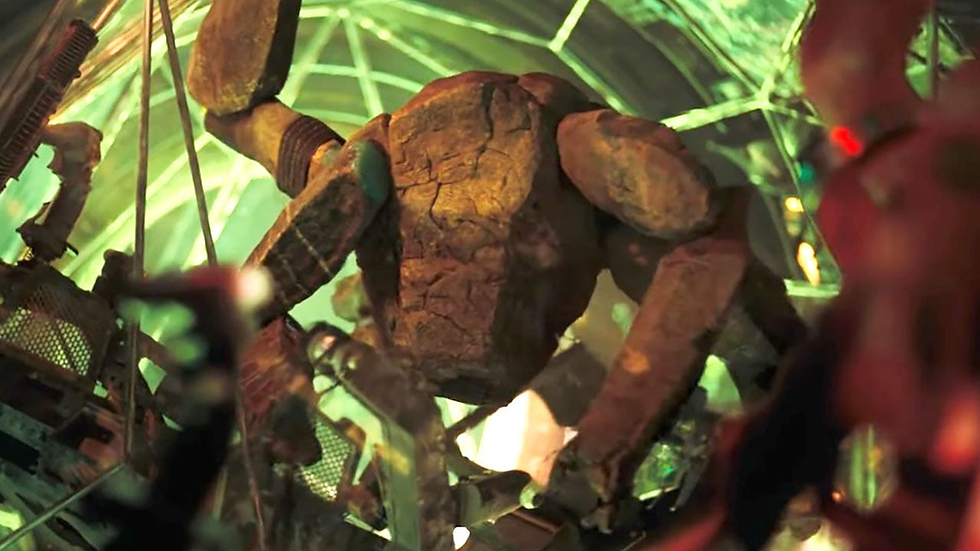
It is a powerful vision, but it is also a contained one. The story focuses on a mission, a defined problem, and a resolution. Real space development does not stop there.
Once exploration becomes infrastructure, once multiple actors, interests, and dependencies emerge, the challenge changes. It becomes less about solving a single problem and more about managing competing ones over time.
That is where science fiction expands the frame.
Infrastructure Is Never Neutral
History offers a clear lesson: infrastructure shapes power. Railroads redefined economies and borders. Energy networks reshaped geopolitics. Digital systems reorganized information and influence.
Space infrastructure will do the same.
A lunar habitat is not just shelter, it is jurisdiction. A fuel depot is not just logistics, it is leverage.A life-support system is not just technology, it is control.
As space becomes an economic domain, these distinctions will matter.
Science fiction enables us to explore them before they become fixed.
A Narrowing Gap
For decades after the Apollo program, space felt distant, technically impressive, but removed from everyday life. That distance is now collapsing in real time.
As Artemis II carries humans back into deep space, images of Earth from beyond low Earth orbit are no longer archival—they are current, shared, and immediate. At the same time, films like Project Hail Mary are shaping how audiences emotionally interpret that journey.
We are no longer imagining a distant future, we are encountering an early version of it.
Why Story Still Matters
Large-scale endeavors require more than technical success, they require meaning.
Apollo succeeded not only because it reached the Moon, but because it was embedded in a story about human progress.
Today’s space age is more complex, commercial, international, and decentralized.
We need stories that help us think through that complexity, not only stories of success, but also stories of consequence.
The Real Frontier
As Artemis carries humans once again around the Moon, the nature of the frontier is beginning to shift.

The challenge is no longer defined solely by propulsion systems or mission design, but by the structures that will shape life beyond Earth. Questions about how access is distributed, how scarce resources are managed, and how communities define themselves in isolated environments are becoming central rather than theoretical.
These are not problems that engineering alone can resolve. They require choices—about governance, equity, and long-term sustainability—that extend well beyond the technical domain.
In that sense, science fiction is not being displaced by real rockets; it is becoming more relevant because of them. Engineering shows us what is possible, but narrative helps us think through what is desirable.
And as that distant, inverted image of Earth reminds us—small, luminous, and alone—the future will depend not only on how far we travel, but on the decisions we make once we arrive.
— Jeremy Clift, author of Born in Space and Space Vault: The Seed Eclipse. Read Clift’s profile on Kirkus.


Comments