Powering the Next Frontier: What Dragonfly Reveals About the Next Age of Spaceflight

By Jeremy Clift, author of Born in Space: Unlocking Destiny
The annual Space Symposium in Colorado Springs is a treasure trove for science fiction writers. Every year, it offers glimpses not only of where space technology is heading, but also of how humanity is beginning to rethink exploration itself.
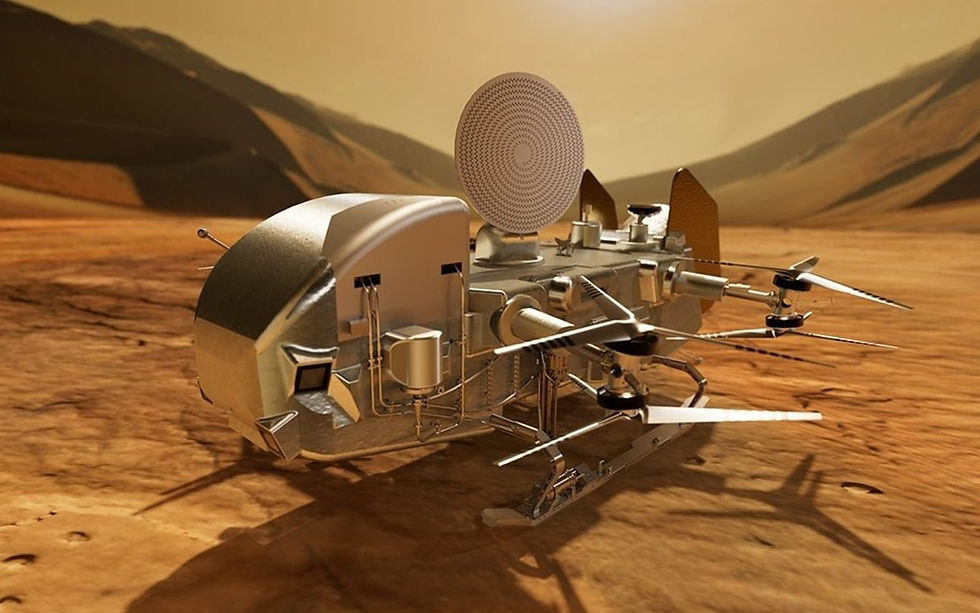
For the second year running, one of the most striking exhibits was the mockup of Dragonfly, a car-sized octocopter designed to explore Saturn’s moon Titan. The ambitious NASA mission is led by the Johns Hopkins Applied Physics Laboratory.
Unlike anything humanity has attempted previously, Dragomfly is a nuclear-powered rotorcraft designed to fly across the surface of Titan, hopping between distant scientific targets in an environment eerily reminiscent of early Earth.
For a novelist, it immediately captures the imagination. Titan itself feels like something drawn from speculative fiction: hydrocarbon lakes, thick orange skies, dunes of frozen organic material, and a chemistry that may resemble conditions that existed before life emerged on Earth.
A nuclear-powered future
But what stayed with me most at the symposium was not only the destination, but the envisaged power source. Because beneath the excitement around rockets and lunar missions, one reality is becoming increasingly clear: the future of deep-space exploration depends not simply on propulsion, but on energy. Reliable, compact, long-duration power systems are quietly becoming the foundation of the next space age.
Dragonfly illustrates that perfectly. The mission is revolutionary not only because it flies, but because of where and how it flies. Titan’s atmosphere is dense and cold, with temperatures approaching minus 180 degrees Celsius. Sunlight at Saturn is roughly one percent as strong as it is near Earth. Conventional solar power becomes dramatically less effective at that distance.
The solution is nuclear power.

Dragonfly will rely on a radioisotope power system, converting heat from decaying plutonium into electricity that can sustain the craft through Titan’s brutal environment. The rotorcraft is expected to make one flight every Titan day—or Tsol—which lasts roughly sixteen Earth days. Between flights, it will sit on the surface conducting experiments, analyzing chemistry, and searching for clues about prebiotic conditions and potentially even exotic forms of life.
An airborne lab
What makes the concept so extraordinary is that it transforms exploration from a stationary exercise into a mobile one. Earlier planetary missions often remained confined to the immediate vicinity of their landing sites. Dragonfly changes that paradigm. It is designed to travel across Titan’s surface, exploring dunes, impact craters, and chemically distinct environments over the course of its mission.
It is, in effect, an airborne laboratory.
And none of it works without continuous power. That may sound obvious, but it points to a larger shift taking place across the space industry. For decades, space exploration was largely episodic: short-duration missions, limited operations, highly constrained objectives. Energy requirements were significant, but manageable.
The future now being discussed is different.
As Artemis pushes human spaceflight back toward the Moon, and companies like SpaceX discuss permanent settlements beyond Earth, space systems are beginning to evolve from missions into infrastructure. That transition changes the energy equation completely.
A sustained human presence on the Moon cannot rely entirely on intermittent solar power. Lunar night lasts roughly fourteen Earth days. Even in polar regions where sunlight is more persistent, shadows and terrain complicate generation and storage. Habitats, communications systems, life support, resource extraction equipment, and industrial processing all require stable energy.
Mars presents different but equally severe challenges. Dust storms can reduce solar efficiency for extended periods. Surface temperatures fluctuate dramatically. Long-term operations demand reliability that cannot depend entirely on environmental conditions.
A new U.S. initiative
This is why nuclear power, once politically sensitive in space discussions, is quietly returning to the center of strategic planning. The shift is now visible at the policy level as well. Earlier this year, the White House released a new national initiative for American space nuclear power, aimed at accelerating the development of nuclear propulsion and power systems for exploration, commercial, and national security applications.

That policy change reflects a broader recognition: if humanity intends to operate sustainably beyond Earth orbit, energy can no longer be treated as an afterthought.
At the symposium, that shift felt unmistakable. The conversation is no longer whether nuclear systems might someday become useful. Increasingly, they are viewed as necessary for sustained exploration beyond Earth orbit. Reliable power changes what kinds of missions become possible. It extends operational duration, reduces vulnerability, and enables entirely new categories of exploration.
Dragonfly is a perfect example. Without nuclear power, Titan remains largely inaccessible. With it, an airborne robotic explorer can roam an alien world for years, carrying instruments across terrain no rover could realistically traverse.
For science fiction writers, this is fertile territory because it reveals something deeper about exploration itself.
We often imagine the future of spaceflight through the lens of rockets. Launches dominate headlines. Engines symbolize ambition. But rockets are only the beginning of the equation. Once you arrive somewhere, survival depends on entirely different systems: energy, heat management, communications, redundancy, maintenance.
Power is destiny
That idea has shaped my own fiction as well. In Space Vault, the vessel SpaceSweeper III—originally designed to retrieve dangerous orbital debris—becomes part of a much more personal journey as Ved searches for his identity and his place between worlds. The ship itself reflects a future in which space infrastructure has become practical, persistent, and deeply integrated into human life. But underlying all of it is the same reality facing real-world engineers: sustained operations in deep space require dependable energy systems.
How do spacecraft operate for years far from Earth? How do habitats remain stable through darkness, radiation, and isolation? How do explorers maintain mobility in environments where sunlight is weak or intermittent?
Those questions increasingly point toward nuclear systems.
As humanity expands outward, the question will be not just how far we can travel. It will be whether we can sustain ourselves once we get there. Not only for robotic exploration, but for human systems as well.
— Jeremy Clift, author of Born in Space and Space Vault: The Seed Eclipse. Read Clift’s profile on Kirkus.



Comments